
Download the DDRSM Checklist for Digital Product Initiatives
DDRSM stands for Dream, Define, Recommend, Solve, Measure.
It’s a process I built over the years because I kept running into the same problem: teams want to do the right thing, but they often start without enough clarity. Everyone is moving, but not always in the same direction.
I didn’t come up with DDRSM to be clever or to create “yet another framework.”
I created it because I needed something that actually worked in real situations, with real people, different priorities, tight timelines, and sometimes messy problems.
DDRSM gives me (and the teams I work with) a way to slow down just enough to understand what we’re solving for, and then move forward with purpose.
Why I use it
Every job, every company, every project has its own set of challenges. But the patterns are surprisingly familiar:
- unclear goals
- unclear users
- unclear success criteria
- lots of opinions
- lots of assumptions
- very little alignment
DDRSM helps cut through that. It gives us structure without being rigid, and enough flexibility to adapt when things change, which they always do.
Over the years, I’ve used this method to help teams:
- get aligned
- make better decisions
- build with more intention
- and connect the “why” to the “what” and “how”
The Five Stages
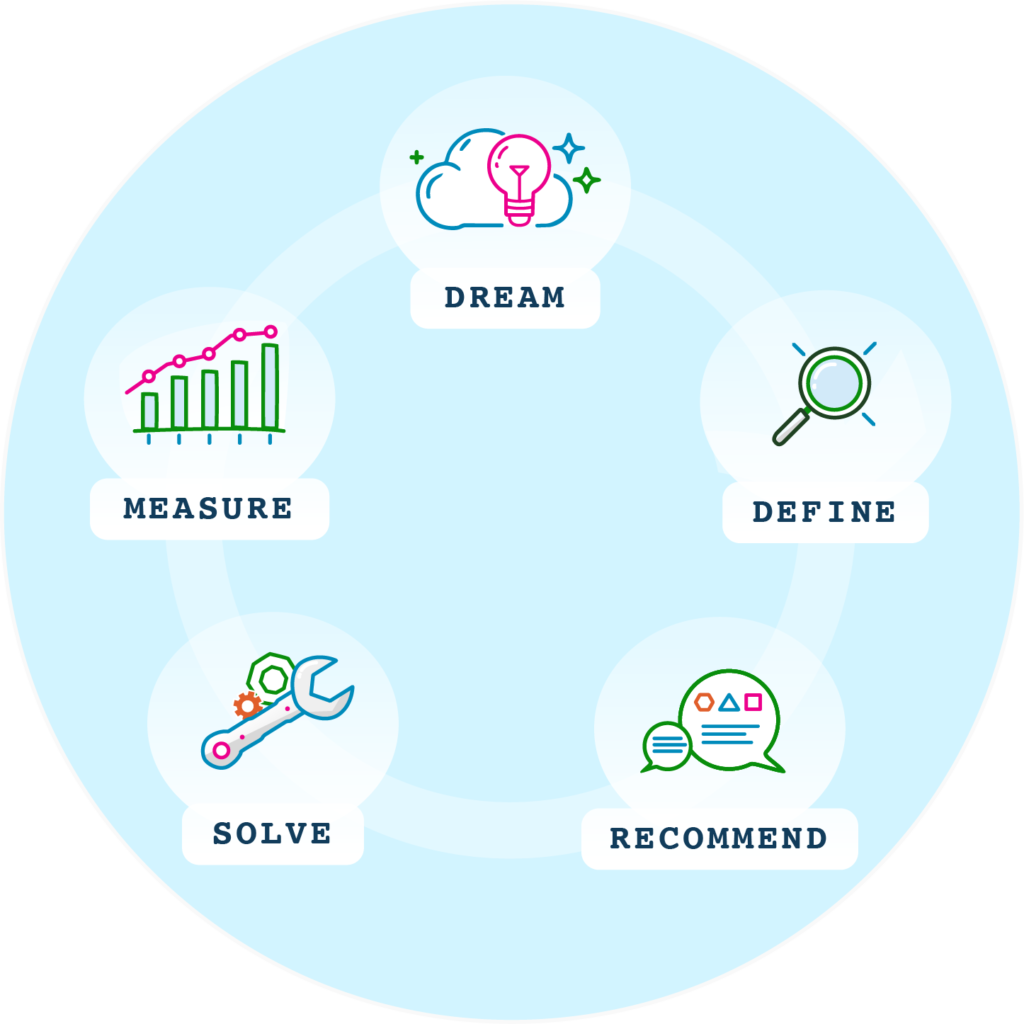
1st. Dream
- What’s the real problem?
- What’s the ideal outcome?
- This is where we get honest about what’s not working and imagine what could be.
2nd. Define
- Who’s involved?
- What do we know?
- What don’t we know?
- This is where we gather the pieces and understand the landscape before we start making decisions.
3rd. Recommend
- Here’s where options come in.
- Not every solution fits every situation, so we look at what’s feasible, what’s realistic, and what actually solves the problem.
4th. Solve
- We build. Test. Adjust.
- This is the part everyone jumps to first – but it works better once Dream and Define are done.
5th. Measure
- Did it work?
- Did it make things better?
- What should come next?
- This part is often skipped, but it’s where the real learning happens.
How DDRSM shows up in my work
I use DDRSM in everything from small UX refinements to large-scale redesigns, service maps, research programs, strategy work, and AI-driven projects.
It’s not a template, it’s a way of thinking.
A recent example is the Employee Initiated Move (EIM) application, where DDRSM helped us understand the real pain points, design a cleaner experience, and measure real improvements. (You can read the case study if you’re curious.)
DDRSM helps me and my teams stay focused on what matters – the problem, the people, and the outcome.
It keeps the work grounded, intentional, and human, which is what good design should feel like.
Check out the articles I authored on this method as part of the Kick Ass Process (KAP) series.
Find the antidote to chaos and avoid headaches.
Kick Ass Process Part 1: Dream, Define, Recommend, Solve, Measure (DDRSM)
How Toyota Became So Successful by Implementing a Process
Kick Ass Process Part 2: A Tale of Process Success
Get in touch
contact@luisbarriga.com
LinkedIn Profile